I’ve seen too many people get sick from something as simple as leaving chicken on the counter to thaw.
You’re probably defrosting food the way your parents did. Maybe the way their parents did. And honestly, that method might be putting you at risk.
Here’s the thing: bacteria multiply fast when food sits in what we call the danger zone. That’s between 40°F and 140°F. Your countertop? Perfect breeding ground.
I’ve spent years testing different thawing methods in my kitchen. Some work. Most don’t. And the ones that don’t can make you seriously ill.
This guide covers three methods for defrosting safely tbtechchef style. Each one is backed by food science, not kitchen myths.
We follow strict food safety protocols here. The methods I’m sharing come from understanding how bacteria grow and how to stop them before they become a problem.
You’ll learn exactly how to thaw meat, poultry, seafood, and vegetables without creating a health hazard. No guesswork. No outdated advice your grandmother swore by.
Just safe, tested techniques that work every time.
The ‘Why’: Understanding the Food Safety Danger Zone
You know that nervous feeling when you realize you forgot to take the chicken out of the freezer?
So you leave it on the counter and hope for the best.
I’ve been there. We all have.
But here’s what’s actually happening while that meat sits there. Between 40°F and 140°F, bacteria like Salmonella and E. coli don’t just survive. They throw a party and multiply like crazy.
Food scientists call this the danger zone for a reason.
When your frozen chicken sits at room temperature, it’s basically an all-you-can-eat buffet for bacteria. They double in number every 20 minutes under the right conditions. That’s exponential growth, which means a few bacteria can turn into millions in just a few hours.
Some people argue that humans have been thawing food at room temperature for centuries without issue. They say our ancestors didn’t have refrigerators and they survived just fine.
Fair point.
But here’s what they’re missing. Our ancestors also dealt with food poisoning way more often than we do. They just didn’t have the data to connect the dots between thawing methods and getting sick.
The goal when you’re defrosting safely isn’t complicated. You want to move food through that danger zone as fast as possible. Or better yet, skip it entirely.
Think of it this way. When food is frozen, it has a protective ice shield around it. That frozen barrier keeps bacteria from doing much of anything. But as soon as you start thawing, that shield melts away.
The outer layers warm up first while the inside stays frozen. And that’s where things get risky.
Those outer layers hit the danger zone and stay there for hours while the center slowly catches up. Bacteria wake up and start multiplying on the surface even though the middle is still rock solid.
Time matters just as much as temperature here.
You’ve probably heard of the two-hour rule for cooked foods. If something sits out for more than two hours between 40°F and 140°F, you’re supposed to toss it. That same principle applies when you’re thawing.
The longer your food hangs out in the danger zone, the more bacteria can grow. And at Tbtechchef, we focus on methods that respect this timeline.
A small piece of fish might thaw in an hour. A whole turkey could take days.
The question isn’t just “how do I thaw this?” It’s “how do I thaw this without giving bacteria hours to multiply?”
That’s the difference between safe defrosting and playing Russian roulette with your dinner.
Gold Standard: Refrigerator Defrosting for Optimal Safety
I’ll be honest with you.
Most people defrost food wrong. They leave it on the counter, run it under hot water, or toss it in the microwave and hope for the best.
I used to do the same thing until I realized I was basically rolling the dice with food safety every time.
Here’s what changed my mind. The refrigerator method isn’t just safer. It’s the only method that keeps your food in what the USDA calls the “safe zone” the entire time (below 40°F).
Some folks argue that countertop thawing is fine if you’re quick about it. They say their grandparents did it for decades without getting sick. And sure, maybe they got lucky. But bacteria multiply fast between 40°F and 140°F. Why risk it?
The fridge method is simple. Place your frozen item in a leak-proof container or on a plate. Put it on the bottom shelf so nothing drips onto your fresh produce or leftovers. Then wait.
That’s the part people hate. The waiting.
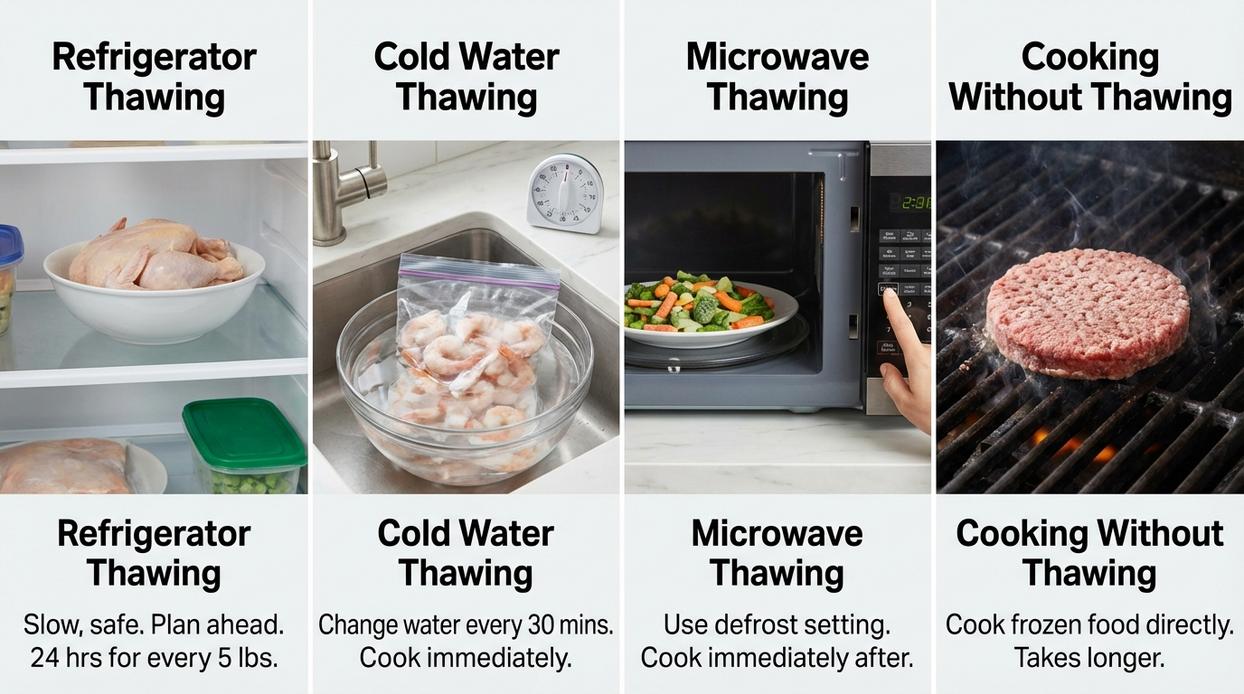
You need about 24 hours for every 5 pounds of meat. A whole chicken takes a full day. Ground beef might be ready in 12 hours. Steaks usually need 12 to 24 hours depending on thickness.
I know it requires planning. But once you get in the habit of moving things from freezer to fridge the night before, it becomes automatic.
Here’s something most people don’t know. Once you’ve thawed something in the fridge, you have a window to use it. Ground meat stays safe for 1 to 2 days. Roasts give you 3 to 5 days.
And this is the only method where you can refreeze raw meat if your plans change. With any other defrosting safely tbtechchef approach, you’re committed once you start.
That flexibility alone makes it worth the extra time.
The Quick & Safe Method: Cold Water Bath
You know what drives me crazy?
When I forget to pull chicken out of the freezer in the morning and now it’s 5 PM and I need to cook dinner.
We’ve all been there. Staring at a rock-solid piece of meat and wondering if we should just order takeout instead.
Some people will tell you to just microwave it or run it under hot water. Quick fix, right?
Wrong. That’s how you end up with partially cooked edges and a frozen center. Or worse, bacteria growing on the outside while the inside is still ice.
Here’s what actually works.
Cold water thawing. It’s faster than the fridge and way safer than hot water.
Why? Water conducts heat about 20 times better than air. That frozen chicken sitting in your fridge might take all day. Put it in cold water and you’re looking at an hour or two max (depending on size).
But you can’t just toss it in a bowl and walk away.
I follow what I call the tbtechchef food technology by thatbites protocol for defrosting safely tbtechchef. Three non-negotiable rules. I walk through this step by step in Food Technology Tbtechchef.
First, seal it up. Your food needs to be in a leak-proof bag. No exceptions. Water seeping in means soggy food and potential cross-contamination.
Second, full submersion. The entire item needs to be underwater. I sometimes use a plate to weigh it down if it keeps floating.
Third, change the water every 30 minutes. This is the part people skip and it matters. The water warms up as it pulls cold from the frozen food. You need fresh cold water to keep the process safe and effective.
And please, use cold water only. Not warm. Not hot. Cold tap water.
Hot water pushes the outer layer into the danger zone (40°F to 140°F) where bacteria multiply like crazy. Meanwhile the center stays frozen. You’re basically creating the perfect environment for food poisoning.
One last thing. Once your food is thawed using this method, cook it right away. Don’t let it sit around. Don’t put it back in the fridge for tomorrow.
Thaw it, cook it, eat it.
The Tech-Forward Approach: Smart Microwave Defrosting
Let me be honest with you.
The microwave gets a bad rap for defrosting. People say it cooks the edges while leaving the center frozen solid. And yeah, that happens if you’re just hitting the highest setting and walking away.
But here’s what most people don’t realize.
Your microwave is probably smarter than you think. If you know how to use it right, it’s the fastest way to get dinner on the table when you forgot to pull something out this morning.
Some folks insist you should never microwave frozen food. They say it ruins the texture and creates uneven results no matter what you do. I hear this all the time.
The thing is, they’re usually doing it wrong.
Modern microwaves have defrost settings for a reason. These aren’t just marketing gimmicks. The tech actually works by cycling power on and off instead of blasting your food with constant heat.
Here’s how it goes down.
When you select the defrost mode, the microwave runs at about 30% power. It heats for a few seconds, then stops. This gives the cold spots time to absorb the warmth from the warmer areas. That’s the whole point of food technology tbtechchef methods like this.
Newer smart models take it further. They use weight sensors and humidity detectors to adjust timing automatically. Pretty cool when you think about it.
But even with good tech, you need to do your part.
First thing? Remove all packaging. That plastic wrap or foam tray can create hot spots or even melt onto your food.
Put everything on a microwave-safe plate. Then check halfway through and flip or rotate the pieces. If you’re defrosting chicken breasts or fish fillets, separate them so they thaw evenly.
Now here’s the part about defrosting safely tbtechchef that matters most. For additional context, How to Defrost Meat Tbtechchef covers the related groundwork.
Once you microwave something, you have to cook it right away. Not in an hour. Not after you prep the rest of dinner. Immediately.
Why? Because the microwave creates warm zones even on the defrost setting. Those spots hit temperatures where bacteria multiply fast. We’re talking the danger zone between 40°F and 140°F.
Your fridge keeps things cold enough to slow bacteria down. Cooking kills them off. But that in-between state? That’s where problems start.
So if you’re going to use this method, make sure your pan is ready and your oven is preheating. The microwave is your go-to when time is tight and you’re cooking now, not later.
Critical Mistakes: Thawing Methods to Absolutely Avoid
Let me tell you about the worst thing you can do with frozen food.
Leaving it on your kitchen counter.
I see this all the time. People pull chicken out of the freezer in the morning and leave it sitting there all day. They figure room temperature will do the job while they’re at work.
Here’s what actually happens.
The outside of that chicken hits 40°F way before the inside thaws. And it sits there. For hours. Right in the bacterial danger zone between 40°F and 140°F where pathogens multiply like crazy.
Your meat’s surface might look fine. But bacteria you can’t see are having a field day.
Then there’s the hot water trick. Some folks think running hot tap water over frozen meat speeds things up without the counter risk.
Wrong on both counts.
Hot water does thaw faster. But it also cooks the outer layer while the inside stays frozen. You end up with mushy texture on the outside and a rock-solid center. Plus, you’re still creating warm spots where bacteria thrive.
Now here’s something that trips people up with defrosting safely tbtechchef methods.
Partial thawing and refreezing.
Say you microwave some ground beef to thaw it quickly. Then your dinner plans change. You think, “I’ll just stick it back in the freezer.”
Bad move. Once food starts thawing, ice crystals melt and bacteria wake up. If you refreeze without cooking first, those bacteria just go dormant again. They’ll be waiting when you thaw it next time.
One more thing. I’ve seen people try to use slow cookers or warming drawers to defrost. The logic seems sound until you think about it. These devices keep food warm, not cold. That means hours in the danger zone again.
Master Defrosting for a Safer, Smarter Kitchen
You now have the complete toolkit for defrosting safely tbtechchef approved.
No more guessing. No more risk.
Improper thawing is a silent threat in your kitchen. But it’s 100% preventable when you know what you’re doing.
The solution is simple: Choose the right method for your timeline. Refrigerator when you can plan ahead. Cold water when you need speed. Microwave when you need it now.
You control your kitchen’s food safety with these choices.
Here’s what to do next: Make these procedures part of your cooking routine. Print them out if you need to. Keep them handy until they become second nature.
A safer meal starts long before you turn on the heat.
Your food deserves proper handling. Your family deserves the peace of mind that comes with it.