
Mastering classic sauce foundations is no longer just about tradition—it’s about understanding how technique, technology, and precision come together in the modern kitchen. If you’re here, you’re likely looking to sharpen your skills, refine your flavors, or explore how smart tools and digital methods can elevate time-honored culinary staples. This article is designed to do exactly that.
We break down the essential building blocks behind the sauces that define professional cooking, while also exploring how temperature control tools, smart appliances, and data-driven recipe adjustments can improve consistency and depth of flavor. Whether you’re a passionate home cook or an innovation-focused culinary enthusiast, you’ll find practical insights that bridge classical training with forward-thinking execution.
Our guidance draws from hands-on testing, emerging kitchen technologies, and proven culinary principles—so you can trust that the techniques shared here are both rooted in tradition and refined for today’s evolving, tech-enhanced cooking environment.
Every unforgettable sauce—from Béchamel to bright tomato—runs on code. Yet many home cooks see saucepans as danger zones: lumps, splits, blandness. Jar A feels safe; homemade B feels risky. But compare them side by side: Jar A offers consistency, shelf life, and flat flavor; homemade B delivers control, freshness, and personality. The difference lies in understanding classic sauce foundations—fat, acid, salt, heat, texture. Master the why, not just the whisking. A roux thickens because starch granules swell; emulsions hold when water and fat are persuaded, not forced (think oil and vinegar negotiating). Precision tools turn guesswork into repeatable results, while instinct adds flair. Learn the code, and you’ll stop fearing breaks and start building signature sauces on demand. Confidence replaces convenience every single time decisively.
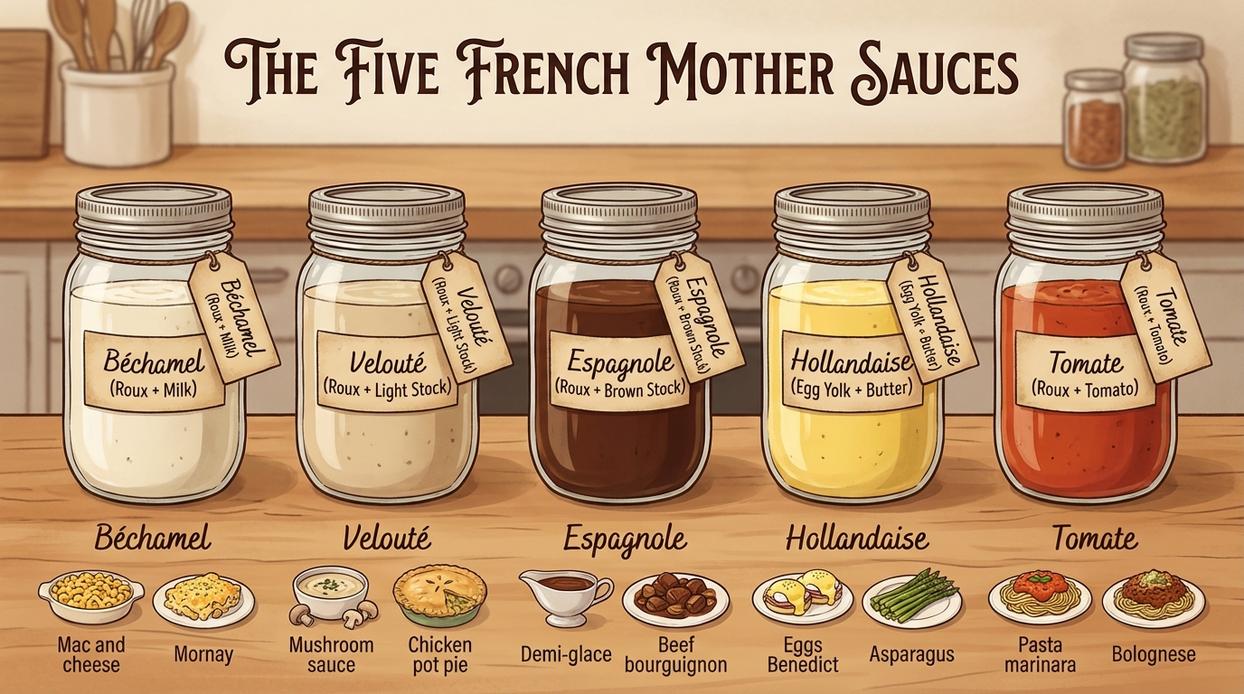
French cuisine rests on five pillars: Béchamel, Velouté, Espagnole, Hollandaise, and Tomate. Known collectively as the classic sauce foundations, they function like culinary root code—master them once, and you can build almost anything.
First, the white sauces. Béchamel begins with a roux (equal parts fat and flour cooked together) whisked with milk. Velouté follows the same method but swaps in white stock. That simple shift creates entirely different futures: Mornay adds cheese to Béchamel, while Allemande enriches Velouté with egg yolk and cream. Some argue these are old-school and overly heavy. I disagree. When balanced properly, they’re as versatile as a good white shirt—hardly outdated.
Next come Espagnole and Tomate. Built on brown stock, mirepoix (a mix of onion, carrot, and celery), and tomato, they deliver depth and structure. Espagnole reduces into demi-glace; Tomate evolves into marinara.
Finally, Hollandaise stands apart—an emulsion, meaning two liquids forced to combine, here egg yolk and butter. It’s temperamental, yes, but so is greatness (just ask any soufflé). Practice patiently, and consistency will follow in your kitchen every time.
The Art of the Roux: Your Primary Thickening Agent
A roux is the simple marriage of equal parts fat and flour, cooked together to thicken and flavor a sauce. In classic sauce foundations, it acts as a thickening agent—meaning it traps liquid in swollen starch granules. “Think of it as edible glue,” one chef told me, laughing.
There are three stages:
- White roux cooks briefly, keeping maximum thickening power and a mild, toasty taste.
- Blond roux turns nutty and golden, sacrificing a bit of strength.
- Brown roux develops a deep, rich flavor but thickens less because longer heat breaks down starches.
“Low and steady,” my instructor warned, “or you’ll taste bitterness.” Consistent, low-to-medium heat prevents scorching; an induction cooktop or digital thermometer keeps temperatures precise. (Pro tip: stay near 300°F for white, higher for darker.)
Finally, follow the “hot vs. cold” rule: add hot roux to cold liquid, or cold roux to hot. “That’s how you dodge lumps,” a line cook said. For smoother workflows, review time management strategies for efficient meal preparation before starting.
The Liquid Foundation: Why Stock is the Soul of Your Sauce
Some cooks argue stock and broth are basically the same thing (liquid is liquid, right?). Not quite. Stock is made primarily from bones and connective tissue, simmered long enough to extract collagen—the protein that gives body and a silky mouthfeel. Broth, by contrast, relies more on meat, resulting in a lighter, more immediately savory flavor. If you’ve ever wondered why restaurant sauces cling like satin, stock is usually the reason.
At its core, great stock requires only a few elements:
- Roasted bones for depth
- Mirepoix (onion, carrot, celery) for balance
- Aromatics like bay, peppercorns, and thyme
- Gentle, slow simmering
Skeptics say simmering for 6–8 hours is outdated. Enter the pressure cooker. In about 60–90 minutes, it extracts comparable gelatin and flavor (seriously, it’s kitchen time travel).
Short on time? Choose low-sodium store-bought stock or bone broth so you control seasoning. Even the classic sauce foundations depend on that flexibility. Pro tip: check for gelatin when chilled—that jiggle means flavor.
The Science of Emulsification: Binding Fat and Liquid
Emulsification is the culinary magic trick that turns two stubborn liquids—like oil and vinegar—into a smooth, unified mixture. By definition, an emulsion is a stable suspension of tiny droplets of one liquid dispersed in another that normally wouldn’t mix. Think of a vinaigrette: without effort, it separates in minutes. With proper technique, it becomes silky and cohesive.
Classic examples include mayonnaise and Hollandaise, both built on classic sauce foundations. In each case, fat is broken into MICROSCOPIC droplets and suspended in water-based liquid. The secret? An emulsifier. Egg yolks contain lecithin, a molecule that binds fat and water. Mustard contains mucilage, which performs a similar bridging role (like a culinary diplomat negotiating peace).
Some argue whisking by hand gives better control—and it can—but consistency is tricky. An immersion blender creates a high-speed vortex that shears fat into ultra-fine droplets, forming a THICK, stable sauce in seconds. Why risk a broken sauce? Pro tip: stream oil slowly at first for MAXIMUM stability.
From Foundation to Flavor Freedom
Mastering thickening with a roux, building depth with stock, and stabilizing emulsions isn’t trivia—it’s leverage. These are the classic sauce foundations that quietly power everything from gravy to glossy pan sauces. Think of it as A vs B: follow a rigid recipe step-by-step, or understand the mechanism and adjust in real time (even when you’re out of cream).
Foundation unlocks freedom.
When you grasp why a roux thickens or how fat and acid bind, you can substitute, scale, or fix a broken sauce without panic.
| Technique | Follow Recipe | Understand Technique |
|————|—————-|———————|
| Roux | Exact ratios only | Adjust thickness on the fly |
| Emulsion | Hope it holds | Fix if it breaks |
Your first step:
- Make a simple Béchamel for mac and cheese or blend a fresh vinaigrette.
This isn’t the finish line. It’s where real creativity begins.
Elevate Your Kitchen With Smarter Flavor Foundations
You came here to master the intersection of culinary pulse and smart kitchen innovation—and now you have the roadmap. From tech-enhanced cooking methods to seamless gastronomic device integration and digital recipe hacks, you’ve seen how precision tools and intelligent systems can transform everyday meals into elevated experiences.
But here’s the truth: without strong classic sauce foundations, even the smartest kitchen can fall flat. The frustration of inconsistent flavor, broken emulsions, or dull sauces is what holds many home cooks back. Technology can guide you—but technique locks in excellence.
Now it’s your move.
Apply what you’ve learned. Experiment with connected thermometers, smart induction controls, and app-guided reductions. Refine your classic sauce foundations with precision timing and temperature control. Build repeatable systems so every dish delivers depth and balance.
If you’re ready to eliminate guesswork, cook with confidence, and turn your kitchen into a high-performance flavor lab, start integrating smarter tools into your next recipe today. Join thousands of forward-thinking cooks already upgrading their approach—explore, test, and taste the difference now.